
For employers hiring workers in safety-sensitive or physically demanding positions, drug and alcohol testing can be an important component of a workplace safety program. One option available to employers is point-of-care drug testing, commonly referred to as POCT.
But what exactly is point-of-care drug testing, how does it work, and when might an employer use it?
At Canadian Occupational Wellness, we provide point-of-care drug testing in Alberta for employers and organizations that require efficient workplace and pre-employment testing. Our services are available through our Alberta locations, mobile occupational health services, and partnered clinics across Canada.
What Is Point-of-Care Drug Testing?
Point-of-care drug testing (POCT) is a drug screening method that allows a specimen to be collected and tested at or near the location where the employee or candidate is being assessed.
Unlike laboratory-based testing, where a specimen is collected and then sent to an external laboratory for analysis, point-of-care testing can provide an initial screening result shortly after the specimen is collected.
Depending on the testing method and panel selected, point-of-care drug tests can screen for multiple drug classes.
The exact substances included depend on the test being used. Common drug classes may include:
- Cannabis/THC
- Cocaine
- Opiates
- Amphetamines
- Methamphetamines
- Benzodiazepines
- Barbiturates
- Methadone
- Buprenorphine
- Other specified drug classes
The substances included in a panel will vary depending on the testing device and the employer’s requirements.
How Does Point-of-Care Drug Testing Work?
Point-of-care drug testing is generally a straightforward process.
The individual provides a specimen according to the testing procedure, and the specimen is screened using an approved point-of-care testing device.
Depending on the type of test being used, the process may involve:
- Confirming the individual’s identity.
- Completing the required testing documentation.
- Collecting the specimen according to the applicable procedure.
- Performing the point-of-care screening.
- Reading and documenting the result according to the manufacturer’s instructions.
- Providing the appropriate result or next-step process.
Many point-of-care drug tests use urine as the specimen. Other testing methodologies may use different specimen types.
The testing provider should follow the manufacturer’s instructions, workplace procedures and applicable standards when conducting the assessment.
What Is the Difference Between Point-of-Care and Laboratory Drug Testing?
One of the most common questions employers have is how point-of-care testing differs from laboratory testing.
The primary difference is where and how the initial screening is performed.
With point-of-care testing, the specimen is screened at the testing location, allowing an initial result to be available quickly.
With laboratory testing, the specimen is collected and sent to a laboratory for analysis.
A point-of-care test is generally a screening test, not the same as a laboratory confirmation.
This distinction is extremely important.
A non-negative screening result does not necessarily mean that an individual has definitively tested positive for a particular drug. Depending on the testing program and applicable procedures, a non-negative result may require further laboratory confirmation.
Employers should therefore have a clear policy outlining what happens following a non-negative screening result.
What Does a Non-Negative Result Mean?
A point-of-care drug test can produce different types of results depending on the testing device and procedure.
A negative result generally means the screening did not detect the targeted substance above the test’s established cutoff.
A non-negative screening result means the test requires further consideration or confirmation according to the applicable testing process.
It is important not to interpret a screening result as a definitive diagnosis of drug use.
Various factors can affect screening results, which is one reason confirmation testing may be required in certain circumstances.
For employers, having a clear process for handling non-negative results is an important part of a responsible workplace drug-testing program.
When Do Employers Use Point-of-Care Drug Testing?
Point-of-care drug testing may be used in a variety of workplace situations, depending on the employer’s policies and applicable legal requirements.
Common situations include:
Pre-Employment Testing
Employers may incorporate drug testing into a pre-employment screening program, particularly for safety-sensitive positions.
This can be relevant in industries such as:
- Construction
- Oil and gas
- Transportation
- Manufacturing
- Utilities
- Heavy equipment operations
- Industrial services
- Remote and camp-based work
- Warehousing and logistics
Post-Incident Testing
Some workplace drug-testing programs may include testing following a workplace incident or accident when the employer’s policy and applicable requirements support testing.
Testing should not automatically be used following every workplace incident. Employers should have clearly established policies and procedures that outline when testing may be appropriate.
Reasonable Cause Testing
Employers may also have policies addressing testing where there are documented and objective reasons to believe an employee may be impaired at work.
Because workplace drug and alcohol testing can involve privacy, human rights and employment-law considerations, employers should ensure their policies are appropriately developed and implemented.
Return-to-Work or Follow-Up Testing
Some workplace programs may also include testing as part of return-to-work or follow-up requirements.
These programs should be developed with appropriate professional and legal guidance and applied consistently.
Why Do Employers Choose Point-of-Care Testing?
One of the primary advantages of point-of-care testing is speed.
Because the initial screening can be performed at the testing location, employers may be able to receive a screening result much sooner than with traditional laboratory testing.
Other potential advantages include:
Convenience: Testing can often be completed at an occupational health clinic or through mobile testing services.
Efficient screening: Initial results can be available quickly, which can be particularly useful during pre-employment onboarding.
Mobile testing: Point-of-care testing can be incorporated into mobile occupational health programs, allowing testing to be completed at suitable workplace or project locations.
Streamlined onboarding: Employers can coordinate drug testing alongside other occupational health services.
Point-of-Care Drug Testing for Safety-Sensitive Positions
Safety-sensitive positions can involve significant responsibilities where impairment could create a serious risk to the worker, coworkers, the public or workplace operations.
Examples may include:
- Commercial drivers
- Heavy equipment operators
- Construction workers
- Industrial workers
- Tradespeople
- Emergency response personnel
- Oil and gas workers
- Remote-site employees
For employers with safety-sensitive positions, drug and alcohol testing may be one component of a broader occupational health and workplace safety program.
However, drug testing should be implemented carefully and in accordance with applicable workplace policies, human rights considerations, privacy requirements and employment law.
Choosing the Right Drug Testing Panel
Not every employer requires the same drug-testing panel.
Depending on the workplace and testing program, employers may choose from different testing panels designed to screen for specific drug classes.
At Canadian Occupational Wellness, employers can discuss their requirements with our team to determine the appropriate testing option for their program.
For example, we offer different point-of-care screening options, including 8-panel and 13-panel testing, depending on the employer’s requirements.
The appropriate panel should be determined based on the organization’s workplace policy and the requirements of the position rather than simply selecting the largest panel available.
Point-of-Care Drug Testing in Alberta
Canadian Occupational Wellness provides point-of-care drug testing in Alberta for employers, contractors and organizations.
Testing can be coordinated through our clinic locations in Sherwood Park and St. Albert, as well as through mobile occupational health services throughout Alberta.
For employers hiring larger groups of workers, multiple occupational health services can also be coordinated during the same appointment or site visit.
Depending on the requirements of the workplace, services may include:
- Point-of-care drug testing
- Alcohol testing
- Pre-employment medical assessments
- Physical abilities testing
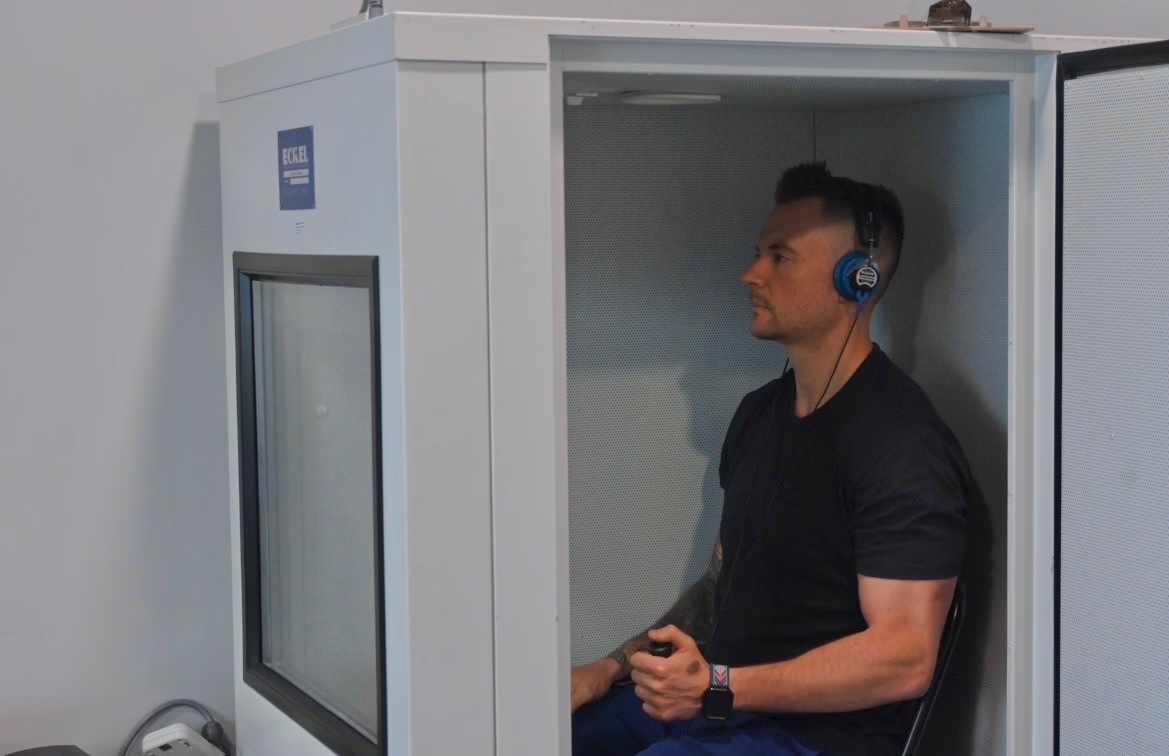
- Audiometric testing
- Respirator fit testing
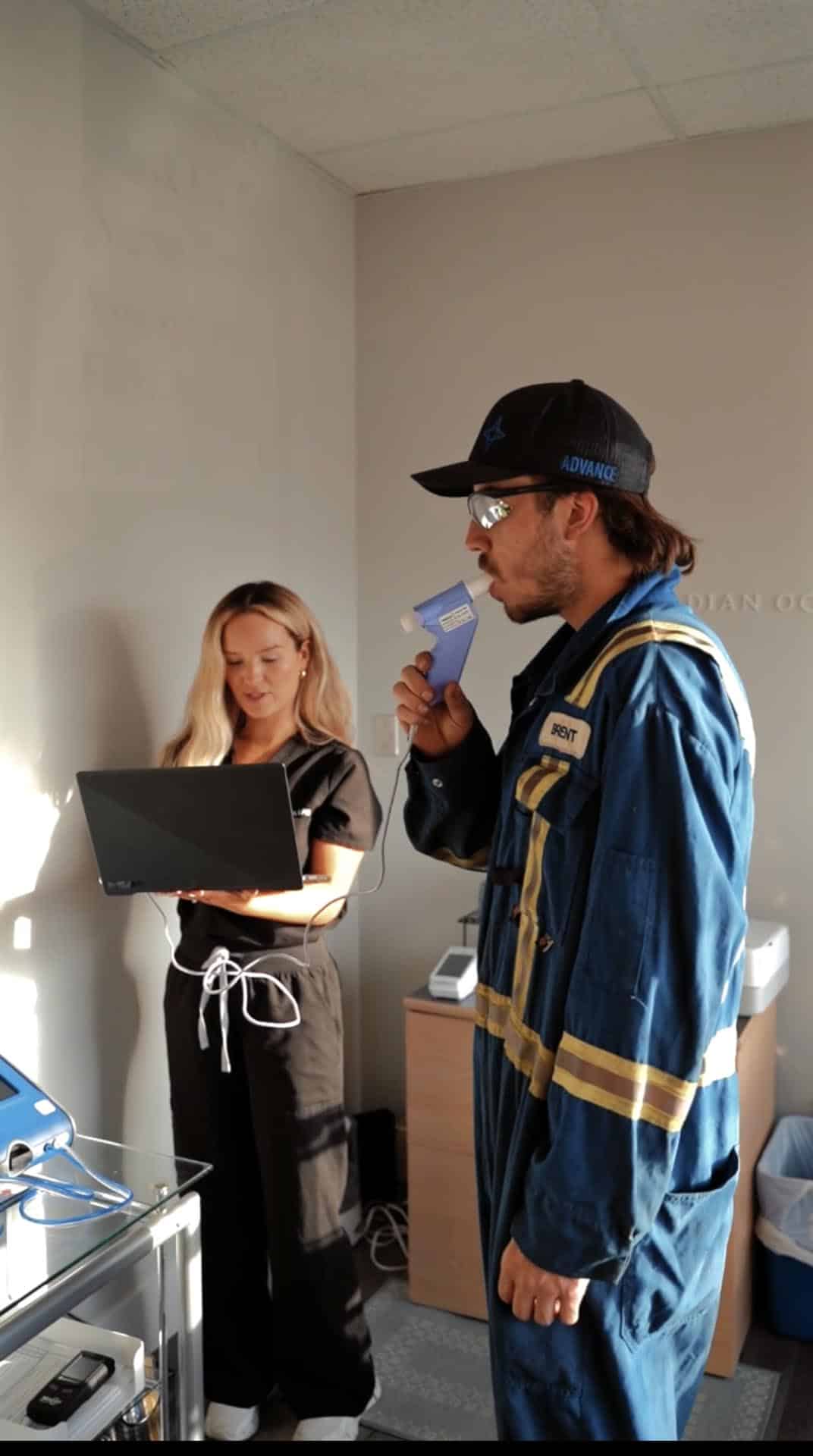
- Spirometry
- Vision screening
- Hearing protection fit testing
Mobile Point-of-Care Drug Testing
For employers with workers spread across Alberta, sending employees to a clinic for testing may not always be the most efficient option.
Mobile occupational health testing allows testing services to be brought directly to an appropriate workplace or project location.
Mobile point-of-care drug testing can be particularly useful for:
- Large hiring groups
- Construction projects
- Industrial sites
- Remote worksites
- Camp-based operations
- Employee onboarding events
- Employers with multiple locations
Canadian Occupational Wellness can coordinate mobile testing throughout Alberta based on the employer’s requirements.
Point-of-Care Drug Testing Across Canada
For companies with employees in multiple provinces, Canadian Occupational Wellness can also coordinate occupational health services through our partnered clinic network across Canada.
This provides employers with a central point of contact while allowing employees outside Alberta to access testing through partnered locations.
For national employers, this can make it easier to maintain a consistent approach to pre-employment and workplace testing across multiple locations.
Is Point-of-Care Drug Testing Right for Your Workplace?
Point-of-care drug testing can provide employers with a convenient and efficient way to conduct initial workplace drug screening.
However, the right testing approach depends on the employer’s industry, workplace policy, job requirements and applicable legal considerations.
Employers should have clear procedures addressing specimen collection, screening results, non-negative results, confirmation testing, confidentiality and reporting before implementing a workplace drug-testing program.
At Canadian Occupational Wellness, we help Alberta employers coordinate point-of-care drug testing as part of their broader occupational health programs.
Whether you need testing for one employee, a new-hire group or a large workforce, our team can assist with scheduling, testing coordination and reporting.
Looking for point-of-care drug testing in Alberta? Contact Canadian Occupational Wellness to discuss your workplace testing requirements.
Canadian Occupational Wellness — Occupational health testing for employers across Alberta and Canada.